Archithek did not come from
an office.
Archithek was born at the kitchen table. With a mayor, a local historian and a list of 3,000 people no one had truly known.
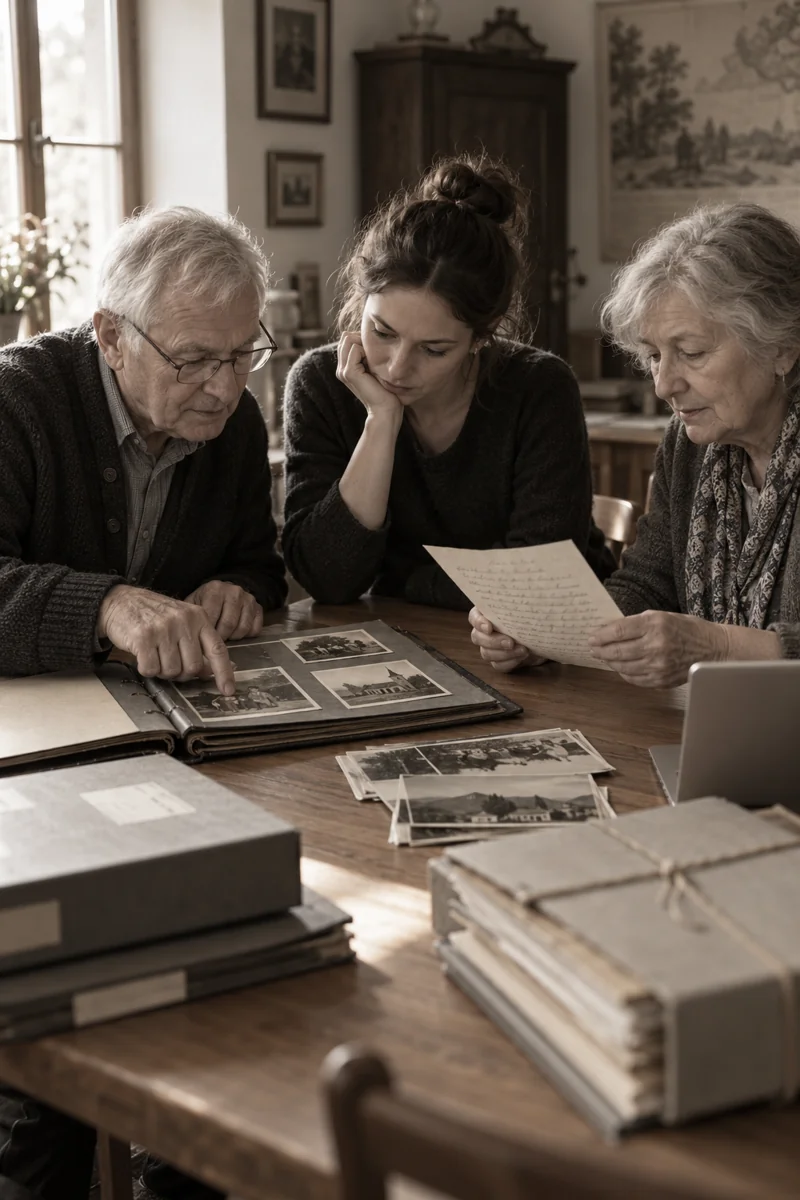 AI illustration
A conversation at the marketplace
A mayor shows us two filing cabinets, three shelves of photos and an Excel file with 3,000 rows. "Is there software that really understands all this?" There wasn't. So we started building one.
The first idea
An archive is not a list. It is a web. A person belongs to a family, who lives in a house, that was inaugurated at a festival, where photos were taken that today lie in a box. It all belongs together — and software has to understand that.
The first real deployment
A community in Upper Bavaria was willing to trust us. Together with the local historian and the administration we used Archithek live — and improved it with every problem. Without that patience Archithek would not be what it is today.
The "approximately" moment
The teacher brought her great-grandmother. No known birth date, only the decade. Archithek must not say "date missing". It should say "approximately 1890" — and place the lady exactly where she belongs. The day we built that changed everything.
A platform for communities
Archithek is live. It gets better every month — not because we plan it that way, but because the people using it make us smarter. That is the heart of it for us: we build software that the archivists, local historians and mayors themselves co-author.
History belongs
to the people
who live it.
Not to the town hall basement.
A community history no one can read is not one. We make it visible — with photos, names, places, stories.
Not to a PDF on a USB stick.
A PDF is a coffin. Archithek is an open book that every generation can keep writing in.
And not to a software company.
Your data belongs to you. You can take everything with you any time — completely, structured, without barriers.
The people who carry Archithek in their minds.
Mayors and administration
The official keepers. They want to secure and bring the archive treasure to life.
Local historians and chroniclers
They know more about the community than any book. They need a tool that thinks with them.
Pastors and association heads
They keep their own chronicles. They should be able to contribute their chapters — without logging in like at a bank.
Teachers and schools
They teach regional history and look for living sources instead of dusty file folders.
Citizens
They want to know something about their grandfather. Or about the house they grew up in.
The next generation
The one that will only ask in 20 years — and whose questions we already take seriously today.
We would love to hear your story.
Call us, write to us. We see it as a privilege to get to know your community.